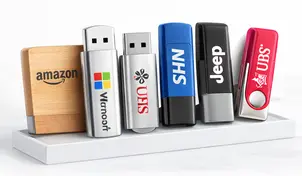
Promotional USB drives remain one of the most effective physical marketing tools available to UK businesses. Unlike disposable flyers or forgettable pens, a well-chosen branded USB stick delivers genuine utility — and every time a recipient plugs it in, your logo is front and centre. However, with dozens of styles, materials, capacities, and branding methods on the market, selecting the right promotional USB for your campaign is not always straightforward.
This guide is designed to help marketing managers, procurement teams, events coordinators, and business owners make a confident, informed decision. Whether you are ordering branded USB sticks for a trade show, a client onboarding pack, or an executive gift set, the choices you make on material, capacity, and branding will directly influence how your brand is perceived — and whether that USB ends up in daily use or forgotten in a drawer.
Below, we examine every factor that matters when choosing promotional USB drives in 2026, from material selection and storage capacity to eco-friendly options, branding techniques, and packaging. We also address the most common mistakes buyers make and provide practical recommendations based on real-world use cases.
Why Promotional USB Drives Still Matter in 2026
With cloud storage and file-sharing platforms widely available, some marketers question whether USB drives are still relevant as promotional items. The evidence suggests they very much are, and for several important reasons.
First, promotional USB drives are functional. Unlike branded merchandise that serves no practical purpose, a USB stick is a tool that recipients use repeatedly — at their desk, in meetings, during travel. Each use is an additional brand impression delivered at no extra cost. Second, USB drives offer a tangible, physical experience that digital marketing simply cannot replicate. In an era of screen fatigue, handing a client a well-crafted wooden or metal USB drive creates a memorable moment that strengthens the business relationship.
Third, USB drives solve a genuine problem for many professionals. Despite the growth of cloud services, many businesses still rely on USB storage for offline file transfers, secure document delivery, IT deployment, and environments where internet access is restricted or unreliable. Professional photographers, in particular, continue to use personalised USB sticks as the preferred method for delivering high-resolution image galleries to clients.
Finally, promotional USB drives offer an excellent cost-per-impression ratio. A single branded USB stick costing a few pounds can generate hundreds or even thousands of brand impressions over its lifetime, making it one of the most cost-effective promotional products available to UK businesses.
Understanding Your Objectives Before You Order
Before examining materials, capacities, and branding options, it is essential to define what you want your promotional USB drives to achieve. The right product depends entirely on the context in which it will be used. Consider the following questions before placing an order:
What is the primary purpose? Are you distributing USBs at a trade show as a mass giveaway? Sending them as part of a premium corporate gift? Using them to deliver preloaded marketing materials, presentations, or product catalogues? Each scenario demands a different approach to material, capacity, and finish.
Who is your audience? A tech-savvy agency audience may appreciate a sleek USB-C drive, whilst a sustainability-focused client base may respond better to an eco-friendly wooden USB. Corporate executives expect a premium feel, whereas conference delegates value convenience and portability.
What is your budget per unit? Promotional USB drives are available across a wide price range. Understanding your budget upfront prevents wasted time exploring options that are not financially viable. Many UK suppliers, including USB Makers, offer competitive pricing from as little as £1.27 per unit with no setup fees, making branded USBs accessible even for smaller campaigns.
What quantity do you need? Some suppliers require minimum orders of 100 or even 500 units. If you are a small business or need a short run for a specific event, look for suppliers offering low minimum order quantities. USB Makers, for example, offers orders from as few as 10 units.
Choosing the Right Material for Your Brand
The material of your promotional USB drive communicates a great deal about your brand before the recipient even plugs it in. Each material carries its own associations, and choosing wisely ensures your USB aligns with your brand positioning.
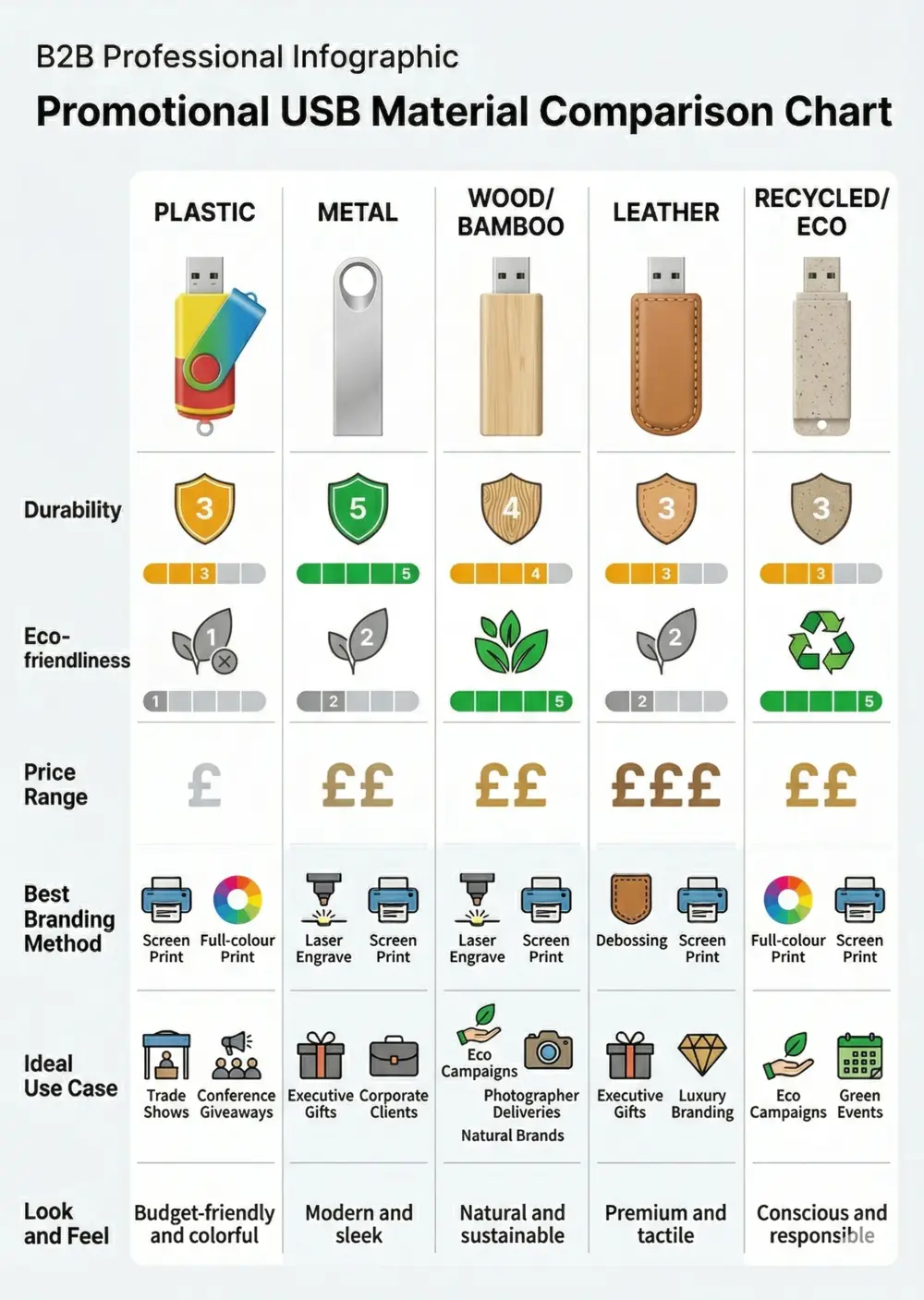
Plastic USB Drives
Plastic remains the most popular material for promotional USB drives due to its affordability, versatility, and wide range of colour options. Plastic drives can be Pantone-matched to your exact brand colours, making them ideal for campaigns where colour consistency is critical. The classic Twister USB — a capless swivel design — is one of the best-selling promotional USB styles in the UK for good reason: it is practical, durable, and offers a generous print area on both sides.
Plastic USBs are best suited for high-volume giveaways such as trade shows, exhibitions, and conference welcome packs where cost efficiency is the priority. They are available in virtually any colour, and the lightweight construction makes them easy to distribute in bulk.
Metal USB Drives
For a more premium look and feel, metal USB drives offer a sleek, professional aesthetic that resonates with corporate clients and executive audiences. Metal drives are heavier, more durable, and convey a sense of quality that plastic simply cannot match. They are particularly well suited for laser engraving, which produces a permanent, elegant finish.
Metal USBs work best as corporate gifts, client welcome packs, and employee recognition items. The added weight gives them a tactile premium quality that recipients notice immediately. If your brand positions itself around quality and reliability, a metal drive reinforces that message.
Wooden and Bamboo USB Drives
Sustainability is no longer a niche consideration — it is a mainstream expectation. Wooden and bamboo USB drives allow businesses to signal their commitment to environmental responsibility through a product that is both beautiful and functional. These drives can be laser-engraved for a natural, understated look that appeals to eco-conscious clients and partners.
Wooden USBs are especially popular with photographers, creative agencies, and brands operating in the sustainability, wellness, and premium food and drink sectors. The natural grain of each drive ensures that every piece is subtly unique, adding a bespoke quality that mass-produced plastic simply cannot replicate.
Leather USB Drives
Leather USB drives occupy the premium end of the promotional market. With their rich texture, warm tones, and ability to be debossed with a company logo, leather drives are the material of choice for luxury brands, professional services firms, and high-value client gifting. They pair exceptionally well with custom USB packaging such as magnetic presentation boxes or velvet-lined gift sets.
The tactile quality of leather creates an emotional connection with the recipient, making these drives ideal for milestone gifts, VIP client packs, and exclusive product launches where the presentation matters as much as the product itself.
Credit Card USB Drives
If portability is paramount, credit card USB drives offer an ultra-slim form factor that fits inside a wallet or cardholder. These drives provide a large, flat print surface — ideal for full-colour branding, event graphics, or even a digital business card pre-loaded with your company’s contact details, portfolio, or product catalogue.
Credit card USBs are particularly effective for networking events, sales meetings, and direct mail campaigns where the USB needs to fit inside a standard envelope. Their novelty factor also makes them a strong conversation starter.
Selecting the Right Storage Capacity
Choosing the correct storage capacity for your promotional USB drives is a balance between cost, practicality, and the impression you wish to create. Ordering too little capacity wastes the opportunity to preload valuable content. Ordering too much adds unnecessary cost to your campaign without a meaningful return.
Capacity Recommendations by Use Case
1GB to 4GB: Suitable for lightweight marketing materials such as digital brochures, PDF catalogues, price lists, and basic presentations. This is the most cost-effective option for high-volume trade show giveaways where the USB itself is the brand impression and the preloaded content is supplementary.
8GB to 16GB: The most popular range for promotional USB drives in the UK. This capacity comfortably accommodates marketing videos, high-resolution product images, detailed presentations, and multiple document formats. It strikes the best balance between cost and utility, ensuring the recipient can use the drive for their own storage needs long after your content has been accessed.
32GB to 64GB: Best suited for professional use cases where large files are involved. Photographers delivering high-resolution image galleries, architects sharing CAD files, and software companies distributing installation packages all benefit from higher capacities. These drives also serve as genuinely useful everyday tools, increasing the likelihood of repeated use and sustained brand exposure.
128GB and above: Reserved for specialist applications or premium executive gifts where the drive itself is intended as a high-value item. At this capacity, the USB drive becomes a legitimate storage device rather than a promotional giveaway, and pricing reflects this accordingly.
USB 2.0 vs USB 3.0 vs USB-C
Data transfer speed is an important consideration, particularly for drives that will hold large files. USB 2.0 drives are adequate for documents and small files, but USB 3.0 offers significantly faster read and write speeds — up to ten times faster in optimal conditions. For audiences working with modern hardware, a USB 3.0 drive delivers a noticeably better experience.
In 2026, USB-C drives are becoming increasingly important. With most modern laptops, tablets, and smartphones now featuring USB-C ports, offering a USB-C or dual-connector drive ensures compatibility across the widest range of devices. This is particularly relevant for tech-savvy audiences, creative professionals, and younger demographics who may not have traditional USB-A ports readily available.
Branding Methods: How to Get Your Logo on a USB Drive
The branding method you select affects both the visual impact and the longevity of your logo on the drive. Different materials support different techniques, and understanding these options ensures you get the best possible result.
Screen Printing
Screen printing is the most common branding method for plastic USB drives. It produces vibrant, accurate colour reproduction and works well for logos with up to four spot colours. Screen printing is cost-effective for large orders and delivers a clean, professional finish. However, it is a surface application and may wear over time with heavy use.
Laser Engraving
Laser engraving is the preferred method for metal, wooden, and bamboo USB drives. The laser removes a thin layer of material to create a permanent, tactile mark that will never fade, peel, or wear away. Engraved logos have a premium, understated quality that works exceptionally well for executive gifts and high-end promotional campaigns. The trade-off is that engraving is single-colour only, so it is best suited for clean, simple logo designs.
Full-Colour Digital Printing
For designs that require photographic imagery, gradients, or complex multi-colour artwork, full-colour digital printing offers the greatest flexibility. This method is particularly effective on credit card USB drives and other flat-surface designs where the entire face of the drive becomes a canvas for your branding. It is also excellent for event-specific graphics, limited edition designs, or drives that need to match a wider campaign aesthetic.
Debossing
Debossing is a technique used primarily on leather USB drives. The logo is pressed into the leather surface, creating an indented impression that is both visually elegant and tactile. Debossing works best with bold, simple logo designs and delivers a luxurious, understated finish that aligns with premium brand positioning.
Resin Dome Stickers
For drives where a raised, glossy logo is desired, resin dome stickers offer an eye-catching alternative. A printed sticker is covered with a clear resin coating that creates a three-dimensional, high-gloss finish. This method is durable and produces a polished look, though it adds slightly to the per-unit cost.
Eco-Friendly Promotional USB Drives
Environmental responsibility is a significant factor in B2B purchasing decisions. Research consistently shows that businesses and consumers prefer to work with suppliers who demonstrate a genuine commitment to sustainability. Choosing an eco-friendly promotional USB is one of the simplest and most visible ways to align your brand with these values.
Sustainable Material Options
Several materials are available for businesses seeking greener alternatives to standard plastic USB drives:
- Bamboo: One of the fastest-growing plants on earth, bamboo is a highly renewable resource that produces attractive, durable USB casings. Bamboo drives can be laser-engraved for a clean, natural finish.
- Sustainably sourced wood: Maple, walnut, and other responsibly sourced woods provide a warm, premium aesthetic with strong eco credentials.
- Recycled plastic: Some manufacturers now offer USB drives made from post-consumer recycled plastics, reducing waste without compromising on durability or colour options.
- Recycled paper and cardboard: For lightweight, short-term use cases, paper-based USB drives offer the most environmentally friendly option available. These are particularly effective for events where sustainability is a core theme.
- Cornstarch (PLA): Biodegradable and compostable, PLA-based drives are made from plant-derived materials and break down naturally at end of life.
Sustainable Packaging
The USB drive itself is only part of the sustainability equation. Packaging also matters. Opt for recyclable cardboard boxes, unbleached paper wraps, or minimal packaging wherever possible. Many suppliers can eliminate plastic poly bags and bubble wrap entirely upon request, replacing them with cardboard inserts and paper-based alternatives. Custom USB packaging from responsible suppliers can reinforce your eco message from the moment the recipient opens the box.
Preloading Data: Maximising the Value of Your USB Drives
One of the most powerful features of promotional USB drives is the ability to preload them with your own content before distribution. This transforms the USB from a blank promotional item into a self-contained marketing asset that delivers your message the moment it is plugged in.
What to Preload
The content you load depends on your objectives and audience. Common preloaded materials include:
- Company brochures and product catalogues in PDF format
- Marketing videos, product demonstrations, and customer testimonials
- Sales presentations and pitch decks
- Software installers, drivers, or application demos
- Digital welcome packs for new clients or employees
- Portfolio galleries for photographers and creative professionals
- Event programmes, speaker bios, and session recordings
USB Makers offers a data preloading service that handles the duplication process for you, ensuring every drive in your order contains identical, accurately loaded content. This is especially valuable for large orders where manual loading would be impractical.
Permanent vs Removable Data
You can choose to have your data loaded as removable files (which the recipient can delete to free up space) or as a permanent, read-only partition. Permanent loading ensures your branding and marketing content remains on the drive indefinitely, whilst still leaving free space for the recipient to use. This is a particularly smart option for drives preloaded with company videos or digital brochures, as it guarantees ongoing brand exposure.
Custom Shaped USB Drives: Making a Statement
For businesses seeking a truly distinctive promotional item, custom shaped USB drives offer an unmatched opportunity to create something unique. These drives are manufactured in bespoke PVC moulds shaped to match your product, logo, mascot, or any design you can envision.
Custom shaped drives are conversation starters. They stand out at trade shows, generate social media engagement, and are far more likely to be kept and displayed than a standard rectangular drive. Examples include drives shaped like buildings, vehicles, food products, musical instruments, and brand mascots. The creative possibilities are virtually unlimited.
The trade-off with custom shapes is a slightly higher per-unit cost and longer lead time due to the mould creation process. However, for high-impact campaigns where memorability is the primary goal, the investment is almost always worthwhile.
Packaging and Presentation
How your promotional USB drive is presented matters more than many businesses realise. The packaging is the first thing the recipient sees, and it sets the tone for the entire experience.
For budget-conscious campaigns, simple polybags or slim cardboard sleeves provide adequate protection at minimal cost. For mid-range campaigns, branded tuck boxes or windowed presentation boxes add a layer of professionalism without significant expense. For premium gifts, magnetic closure boxes, branded gift boxes, and custom tins elevate the perceived value of the USB drive and create a genuine unboxing experience.
Consider matching your packaging to the occasion. A trade show giveaway needs quick, easy-to-distribute packaging. A corporate Christmas gift demands something more substantial. A photographer’s client delivery may call for an elegant, branded box that the client keeps long after the photos have been transferred.
Common Mistakes to Avoid When Ordering Promotional USB Drives
Even experienced buyers can make errors that reduce the impact of their promotional USB campaign. Here are the most common pitfalls and how to avoid them.
Choosing capacity based on price alone. Ordering the cheapest, lowest-capacity drives may save money upfront, but a 512MB or 1GB drive offers negligible utility in 2026. Recipients are unlikely to use such a drive regularly, which defeats the purpose of a promotional item. Invest in at least 8GB to ensure the USB has genuine day-to-day value.
Neglecting USB-C compatibility. As USB-C becomes the dominant standard, distributing drives with only a USB-A connector risks alienating a significant portion of your audience — particularly those using newer laptops and mobile devices. Dual-connector or USB-C-only drives are worth the modest additional cost.
Overlooking artwork guidelines. Your logo will only look as good as the file you provide. Low-resolution images, overly complex designs, and incorrect colour profiles all result in subpar branding. Always supply vector artwork (AI, EPS, or high-resolution PDF) and request a visual proof before production begins.
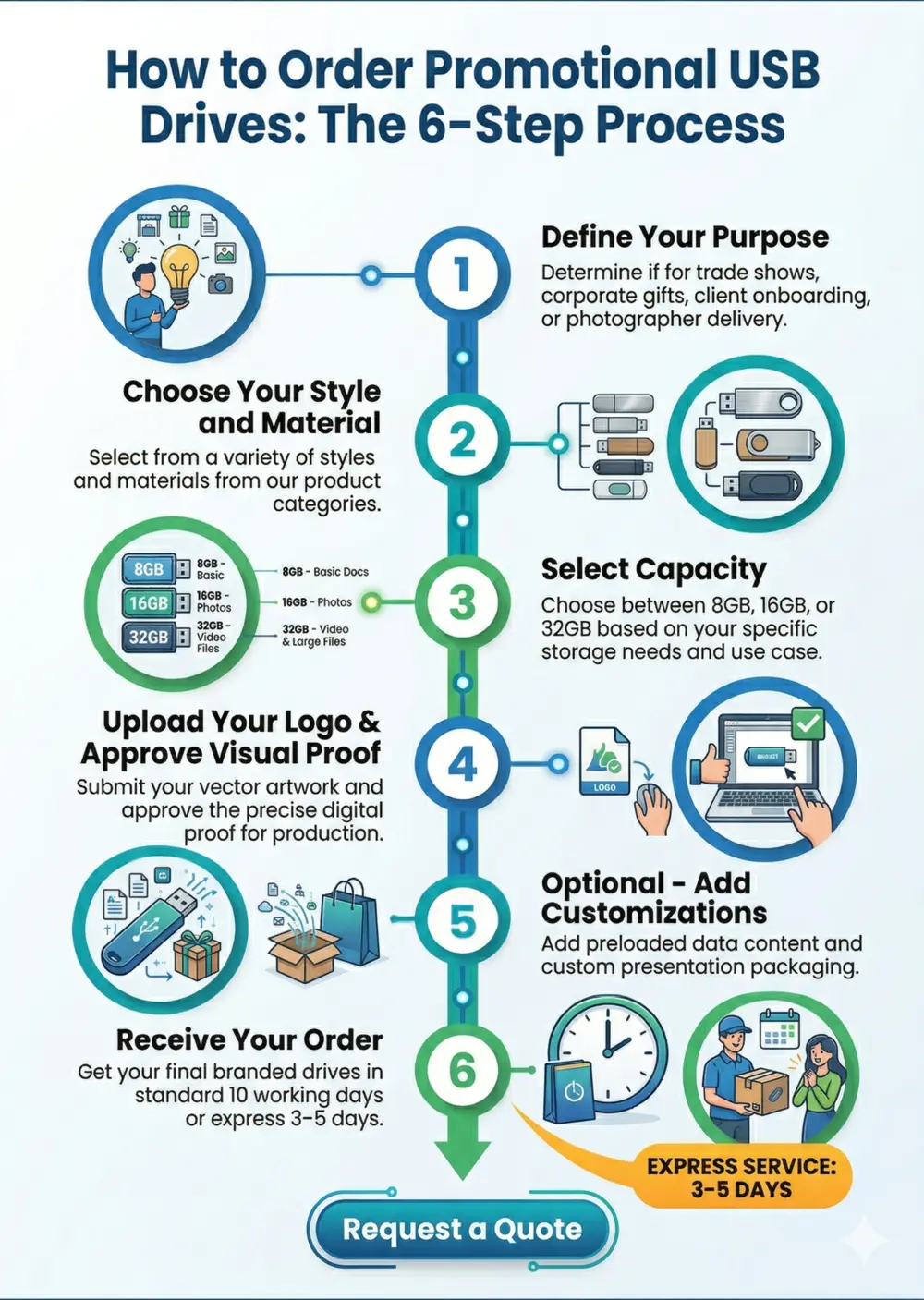
Ignoring lead times. Standard production for branded USB drives typically takes 10 to 15 working days. If you have an event deadline, plan accordingly. Many suppliers offer express services for tighter timescales, but these should be a contingency rather than the default plan.
Forgetting to test preloaded data. If you are preloading content, always request a sample drive before the full order ships. Check that files open correctly, videos play without errors, and the folder structure is logical and professional. A preloaded drive with broken links or corrupted files reflects poorly on your brand.
Matching USB Drives to Specific Use Cases
Trade Shows and Exhibitions
For events with high footfall, prioritise cost efficiency and visual impact. Twister or classic plastic drives in your brand colours, preloaded with a digital brochure or product video, are the optimal choice. Order generous quantities — running out of giveaways at a busy exhibition is a missed opportunity.
Corporate Gifting and Client Onboarding
For client-facing gifts, invest in premium materials — metal, leather, or wooden drives presented in branded packaging. Preload the drive with a welcome pack, company overview, or personalised content. The goal is to make the recipient feel valued, so quality and presentation should take priority over volume.
Photographer Client Deliveries
Professional photographers require drives that are both beautiful and functional. USB drives for photographers are typically wooden or leather, paired with elegant packaging, and available in higher capacities (16GB to 64GB) to accommodate large image galleries. The drive itself becomes part of the premium experience that clients are paying for.
Employee Welcome Packs
A branded USB drive loaded with onboarding documents, company handbooks, training videos, and IT setup guides makes a practical and professional addition to any new employee welcome pack. Mid-range drives in company colours with a clear logo are ideal for this purpose.
Direct Mail Campaigns
Credit card USB drives are purpose-built for direct mail. Their slim profile fits inside a standard envelope, and the large, flat surface provides ample space for eye-catching graphics and a compelling call to action. Preload with an exclusive offer, product demo, or landing page link to drive measurable responses.
How to Evaluate a Promotional USB Supplier
Not all USB suppliers are equal. When evaluating potential partners, consider the following criteria:
- Product range: Does the supplier offer a wide variety of styles, materials, and capacities? A limited range restricts your creative options.
- Minimum order quantities: Can they accommodate small orders as well as large campaigns? Suppliers with low MOQs offer greater flexibility for businesses of all sizes.
- Branding quality: Request samples before committing. Check print clarity, colour accuracy, and durability. Ask about logo branding options and Pantone matching capabilities.
- Lead times: Reliable suppliers provide clear timescales and meet them consistently. Express services should be available for urgent orders.
- Customer reviews: Independent review platforms provide honest insight into a supplier’s reliability, product quality, and customer service.
- Data preloading: If you need content preloaded, ensure the supplier offers this service and can handle your file sizes and formats.
- Pricing transparency: Hidden fees for setup, printing, delivery, or artwork adjustments can inflate costs significantly. Look for suppliers who include these in the quoted price.
Frequently Asked Questions
For most promotional campaigns, 8GB to 16GB offers the best balance of cost and utility. This range provides enough storage for preloaded marketing content whilst leaving ample free space for the recipient to use the drive for their own files. For photographer deliveries or software distribution, 32GB or higher is recommended.
Standard production and delivery typically takes 10 to 15 working days from artwork approval. Express services can reduce this to as little as 3 to 5 working days, depending on the supplier and the complexity of the order. Always confirm lead times before placing your order, especially if you have an event deadline.
Yes. Most reputable suppliers offer a data preloading service where your files are duplicated onto every drive in the order. This is ideal for marketing materials, presentations, product videos, and digital catalogues. Some suppliers also offer permanent data partitioning, where your content is locked onto the drive in a read-only format whilst the remaining space is available for the recipient’s use.
Minimum order quantities vary by supplier. Some require 50 to 100 units as a minimum, whilst others cater to smaller orders. USB Makers offers a minimum order of just 10 units, making branded USBs accessible for small businesses, boutique agencies, and niche campaigns.
Yes. Wooden, bamboo, and recycled material USB drives are fully functional and durable. The internal components are identical to those in standard plastic drives — only the external casing differs. Bamboo and hardwood casings are, in many cases, more resilient to everyday wear than budget plastic alternatives.
USB 3.0 is recommended for most use cases in 2026. It offers significantly faster data transfer speeds, which is particularly important if you are preloading large files such as videos or high-resolution images. USB 2.0 remains adequate for drives containing only documents and small files, and it is available at a lower price point for budget-sensitive campaigns.
Yes. Custom shaped USB drives are manufactured using bespoke PVC moulds and can be designed to replicate virtually any shape — your product, your mascot, a building, or an abstract design. Custom shapes require a longer lead time due to the mould creation process but deliver exceptional brand impact and memorability.
Conclusion
Choosing the right promotional USB drives for your business comes down to understanding your audience, your objectives, and the impression you want to create. Material, capacity, branding method, and packaging all play a role in determining whether your USB drive becomes a valued everyday tool or an afterthought.
In 2026, the smartest choices tend to involve USB 3.0 or USB-C technology, capacities of 8GB or higher, sustainable materials where appropriate, and professional branding that does justice to your logo. Preloading content transforms a blank drive into a self-contained marketing asset, and thoughtful packaging elevates the entire experience.
If you are ready to explore your options, request a free quote from USB Makers and receive a visual proof of your branded USB design with no obligation. With low minimum orders, free UK delivery, and a wide range of styles and materials, we make it easy for businesses of every size to harness the power of promotional USB drives.