USB-C vs USB-A Promotional Drives: Which Should Your Business Choose in 2026?
At a glance
- USB-C is the reversible modern connector; USB-A is the classic rectangular one still found everywhere.
- USB-C suits modern phones and laptops; USB-A works with virtually any computer.
- Dual-connector drives cover both, future-proofing your giveaway.
- Match the connector to the devices your audience actually uses.
The landscape of branded USB flash drives is shifting. With the European Union’s Common Charger Directive now mandating USB-C across most consumer electronics, and laptop compliance required from April 2026, businesses ordering promotional USB drives face a decision that did not exist just a few years ago: should you invest in USB-C, stick with USB-A, or opt for a dual-connector solution?
This is not merely a technical question. The connector you choose affects how recipients experience your brand, whether they can actually use your drive on their devices, and how forward-thinking your business appears to clients and partners. Get it wrong, and your carefully branded flash drive sits in a drawer unused. Get it right, and it becomes an everyday tool that keeps your logo in front of decision-makers for months or even years.
This guide provides a clear, practical framework for UK businesses, marketing agencies, events companies, and corporate buyers to make the right choice for their next promotional campaign.
Understanding the Two Connectors
USB-A: The Familiar Standard
USB-A is the rectangular connector that most professionals recognise immediately. It has been the dominant USB form factor since the late 1990s and remains present on the vast majority of desktop computers, older laptops, gaming consoles, and enterprise workstations currently in use across UK offices.
The key characteristics of USB-A for promotional purposes are its near-universal recognition and compatibility. When a recipient receives a USB-A branded drive at a trade show or in a corporate gift pack, they almost certainly have a device that can accept it without any adapter. This plug-and-play simplicity has made USB-A the default choice for promotional USB sticks for over two decades.
However, USB-A has notable limitations. The connector is not reversible, meaning users must orient it correctly before insertion – a minor frustration, but one that affects the user experience. More significantly, USB-A is being gradually phased out of newer devices. Many modern laptops, particularly those from Apple, now ship without any USB-A ports at all.
USB-C: The Modern Standard
USB-C is a smaller, oval-shaped connector that can be inserted in either orientation. It was introduced in 2014 and has since become the standard connector on virtually all new smartphones, tablets, and an increasing proportion of laptops and peripherals.
Beyond its reversible design, USB-C supports significantly faster data transfer speeds when paired with modern USB standards. A USB-C drive operating on USB 3.2 Gen 2 can transfer data at up to 10 Gbps – twenty times faster than a standard USB 2.0 drive. For businesses pre-loading marketing materials, product catalogues, or high-resolution media onto their branded USB drives, this speed difference is meaningful.
USB-C also supports USB Power Delivery, enabling higher-wattage charging through the same connector. While this is less relevant for flash drives specifically, it underscores the versatility of the USB-C ecosystem and explains why device manufacturers are standardising on it.
The Regulatory Shift: Why This Decision Matters Now
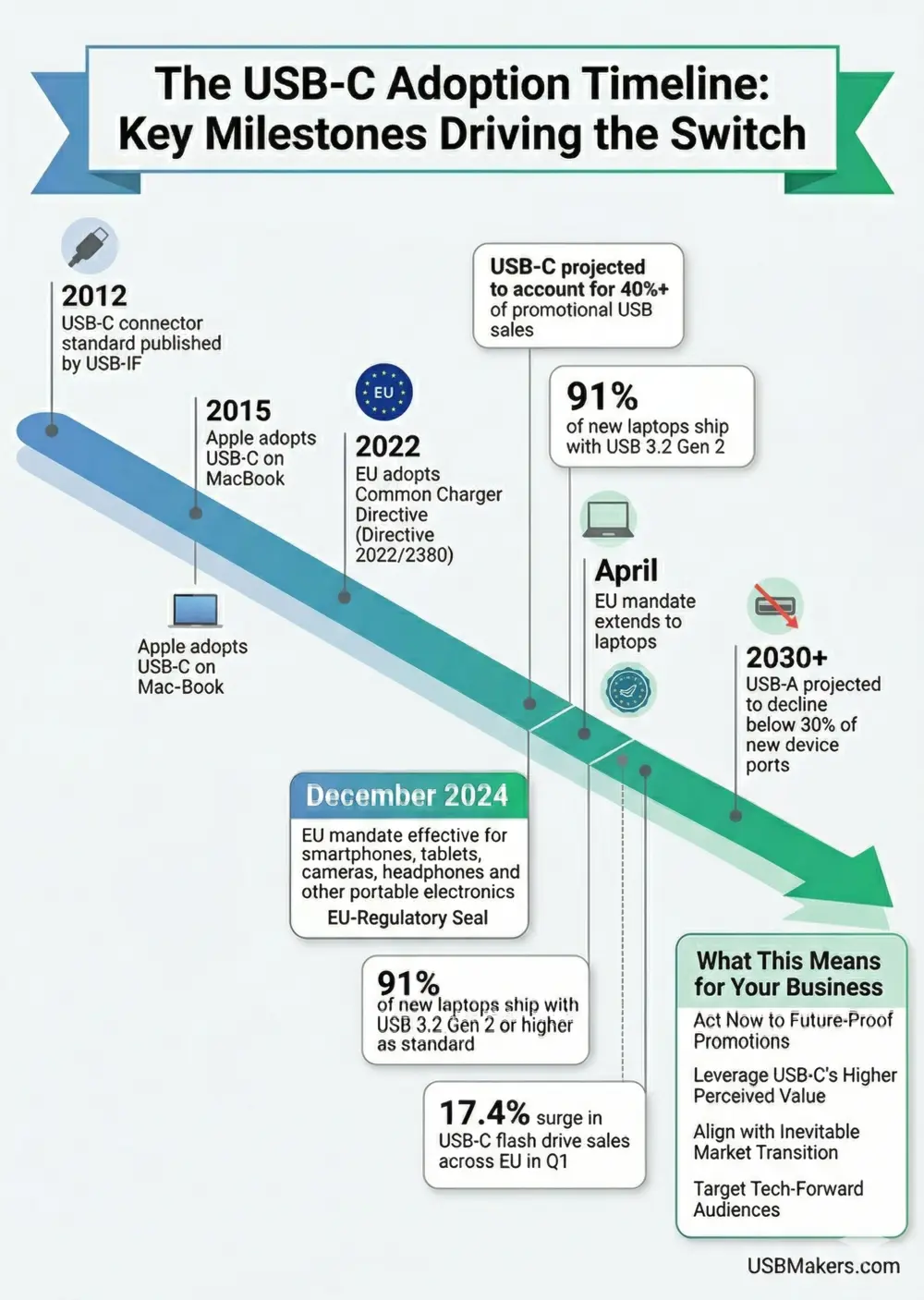
The most significant factor driving the USB-C conversation in 2026 is the EU Common Charger Directive (Directive 2022/2380). This regulation has fundamentally changed the electronics landscape in ways that directly affect the promotional products industry.
Since December 2024, all new mobile phones, tablets, digital cameras, headphones, portable speakers, e-readers, keyboards, mice, and portable navigation systems sold within the EU must include a USB-C charging port. From April 2026, this requirement extends to laptops. The directive aims to reduce electronic waste – estimated at 11,000 tonnes annually from discarded chargers alone – and save consumers approximately 250 million euros per year.
Although the United Kingdom is no longer bound by EU directives following Brexit, the practical impact is substantial. The vast majority of consumer electronics sold in the UK are manufactured for global markets, and manufacturers are not producing separate UK-specific versions with different connectors. The devices your clients, partners, and event attendees carry in 2026 are increasingly USB-C devices, regardless of UK regulatory requirements.
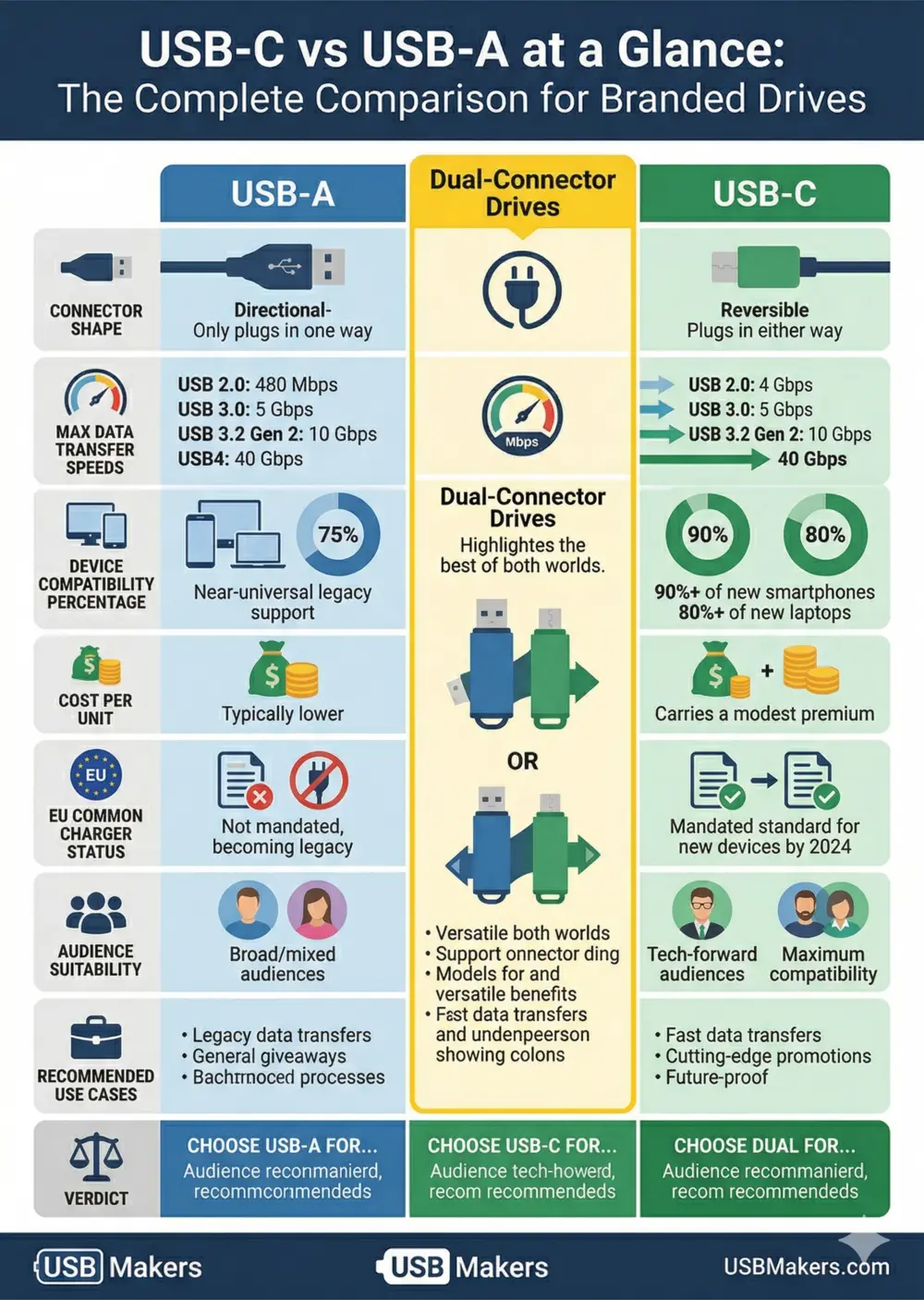
Industry data supports this shift. Research indicates that over 90 per cent of new smartphones and approximately 80 per cent of new laptops now ship with USB-C connectivity. Forecasts suggest USB-C could account for more than 40 per cent of promotional USB drive sales by the end of 2026, with that figure continuing to climb.
Comparing USB-C and USB-A for Promotional Drives
Compatibility and Audience Reach
This is the most critical factor for any promotional campaign. A branded USB drive that cannot be used is worse than no drive at all – it creates a negative brand association rather than a positive one.
USB-A currently offers the broadest compatibility across the installed base of devices. Most desktop computers, enterprise workstations, and laptops manufactured before 2020 include at least one USB-A port. If your target audience includes government departments, educational institutions, NHS trusts, or businesses that refresh hardware on longer cycles, USB-A remains the safer choice for guaranteed usability.
USB-C is the correct choice when your audience predominantly uses modern devices. Marketing agencies, technology companies, creative studios, and professionals who carry MacBooks or recent Windows ultrabooks will have USB-C ports readily available. For these audiences, a USB-C drive signals that your business understands their world.
For campaigns targeting a mixed or unknown audience – such as large trade shows or conferences – neither connector alone provides complete coverage.
Data Transfer Speed
The speed at which files transfer from a branded drive to a recipient’s device directly affects their experience with your brand. A slow, frustrating transfer creates a poor first impression.
USB-A drives are available in multiple speed tiers. USB 2.0 drives, which remain common in the budget promotional segment, offer a maximum theoretical transfer rate of 480 Mbps. USB 3.0 (also known as USB 3.2 Gen 1) drives increase this to 5 Gbps. For most promotional use cases – transferring a product catalogue, a set of marketing PDFs, or a branded presentation – USB 3.0 speeds are more than adequate.
USB-C drives, when paired with USB 3.2 Gen 2 interfaces, can reach 10 Gbps. Some newer drives leveraging USB 3.2 Gen 2×2 achieve 20 Gbps. These speeds become particularly relevant when pre-loading large media files, high-resolution video content, or extensive image libraries. Professional photographers delivering wedding galleries, for example, benefit significantly from faster transfer speeds.
It is important to note that the connector type alone does not determine speed. A USB-C drive operating on USB 2.0 protocol will be no faster than a USB-A 2.0 drive. Always verify the USB standard – not just the connector shape – when ordering.
Cost Considerations
Budget is a practical reality for every promotional campaign, and connector choice does affect unit cost.
USB-A drives benefit from decades of manufacturing scale and remain the most cost-effective option for large-volume orders. They are available across the widest range of styles, materials, and capacities, and their production costs are well-established.
USB-C drives carry a modest price premium, though this gap has narrowed considerably as production volumes have increased. The premium is most noticeable at lower capacities and higher volumes, where even small per-unit differences multiply across an order.
Dual-connector drives – which feature both USB-A and USB-C connectors on a single device – represent a higher price point but offer the broadest compatibility from a single unit. For campaigns where universal usability is paramount, the additional cost per unit is often justified by the increased likelihood that every recipient will actually use the drive.
Brand Perception and Positioning
The connector you choose communicates something about your business, whether you intend it to or not.
A USB-C drive signals modernity, technical awareness, and forward-thinking investment. It suggests that your organisation is keeping pace with technology trends and cares about providing recipients with a product that aligns with their current devices. For technology companies, creative agencies, and businesses targeting younger or more tech-savvy audiences, this signal is valuable.
A USB-A drive, by contrast, signals reliability and practicality. It communicates that your business has prioritised universal accessibility over novelty. For audiences in traditional industries, government, education, or sectors with longer hardware refresh cycles, this is often the more appropriate message.
Neither choice is inherently better – the right answer depends entirely on your audience and brand positioning.
The Dual-Connector Solution
For many UK businesses, the most practical answer in 2026 is a dual-connector promotional USB drive that includes both USB-A and USB-C interfaces on a single device.
Dual-interface drives eliminate the compatibility guessing game entirely. Whether a recipient uses a brand-new MacBook with only USB-C ports or an enterprise Dell workstation with USB-A, the drive works seamlessly. This is particularly valuable for:
- Trade shows and conferences where attendees carry a diverse range of devices and you cannot predict which ports they have available
- Corporate gift campaigns distributed across multiple departments or client organisations with varying hardware standards
- Photographer USB packages where clients may use different devices to view and download their images
- Marketing agency distributions where recipients span multiple industries and technology profiles
The dual-connector approach also future-proofs your investment. As USB-C adoption continues to accelerate, a dual drive purchased today will remain fully functional for years, whereas a USB-A-only drive may become increasingly difficult for recipients to use as older devices are retired.
USB Makers offers a range of dual-connector USB-C and USB-A drives that combine both interfaces with USB 3.0 speeds, available in capacities from 8GB to 64GB with full logo branding.
Making the Right Choice: A Decision Framework
Rather than offering a one-size-fits-all recommendation, the following framework helps you match your connector choice to your specific campaign requirements.
Choose USB-A When:
- Your target audience works primarily in government, education, healthcare, or traditional enterprise environments
- Budget is the primary constraint and you need maximum volume at the lowest cost per unit
- The promotional drives will be distributed to a broad, general audience where device types are unpredictable and skew older
- Your pre-loaded content is lightweight (PDFs, documents, small presentations) and does not require fast transfer speeds
Explore the full range of branded USB-A flash drives at USB Makers, available from just 10 units with free delivery and no setup fees.
Choose USB-C When:
- Your audience consists primarily of technology professionals, creative agencies, or businesses that refresh hardware frequently
- Brand perception as modern and forward-thinking is important to your campaign goals
- You are pre-loading large media files, video content, or high-resolution images that benefit from faster transfer speeds
- You are targeting attendees at technology conferences, digital marketing events, or creative industry trade shows
Choose Dual-Connector When:
- You are distributing drives at large events where attendees carry a mix of legacy and modern devices
- You cannot predict or control which devices your recipients use
- You want to maximise the useful lifespan of your promotional investment
- Your campaign targets multiple audience segments with different technology profiles
Practical Considerations for UK Businesses
Pre-Loading Content
Regardless of connector choice, pre-loading your branded drives with relevant content dramatically increases their effectiveness as a marketing tool. A drive that arrives loaded with your product catalogue, a promotional video, pricing information, or a digital brochure provides immediate value to the recipient and ensures your message is delivered the moment the drive is first used.
USB Makers offers free data loading on all orders, allowing you to maximise the marketing impact of your branded drives without additional cost.
Capacity Selection
The connector type should influence your capacity decision. USB-C drives are often associated with higher-capacity, higher-performance use cases. Ordering a USB-C drive with only 2GB of storage may seem mismatched with the modern, high-performance image that USB-C conveys. For USB-C and dual-connector drives, consider 16GB or above to align the capacity with the premium positioning of the connector.
For USB-A drives intended for high-volume, cost-effective distribution, capacities of 4GB to 8GB remain practical for most promotional content loads.
Style and Branding Options
Both USB-A and USB-C drives are available in a wide range of materials and styles, including metal, wood, plastic, and eco-friendly options. USB Makers provides over 100 drive styles across both connector types, with branding options including screen printing, laser engraving, epoxy dome resin printing, and full-colour digital UV printing.
For businesses prioritising sustainability, eco-friendly USB drives are available in both USB-A and USB-C formats, manufactured from recycled materials, sustainable wood, and biodegradable plastics.
Minimum Order Quantities and Turnaround
One advantage of working with a specialist UK supplier is access to low minimum order quantities and fast turnaround times. USB Makers offers minimum orders from just 10 units on select drives, with an express service offering next-day dispatch on a range of USB styles with full branding. This flexibility is particularly valuable for small businesses, agencies managing client campaigns, or event organisers working to tight deadlines.
Industry Trends Shaping the Future
Understanding where the market is heading helps ensure your promotional investment remains relevant beyond the immediate campaign.
The global USB flash drive market continues to grow, with industry valuations exceeding six billion US dollars and compound annual growth rates consistently above seven per cent. Within this market, USB-C drives represent the fastest-growing segment, driven by both regulatory mandates and organic device adoption.
Several trends are particularly relevant for promotional buyers in the UK:
- Accelerating USB-C device adoption: As older devices are retired and replaced, the installed base of USB-C-compatible devices grows with every hardware refresh cycle. By 2028, USB-C is expected to be the majority connector across all device categories.
- Rising demand for dual-interface drives: Industry data suggests dual-connector drives now represent approximately 29 per cent of purchases among technology-oriented buyers, and this share is growing as businesses seek maximum compatibility.
- Sustainability requirements: Many large UK corporations now include sustainability criteria in their procurement policies for promotional merchandise. Eco-friendly USB drives with responsible material sourcing are increasingly expected rather than optional.
- Pre-loaded content as standard practice: The expectation that promotional drives arrive loaded with useful content is becoming the norm. Empty drives are increasingly perceived as a missed opportunity rather than a blank canvas.
Common Mistakes to Avoid
Based on common pitfalls observed in the promotional USB market, the following mistakes are worth noting:
Assuming USB-C means faster. The connector type does not inherently determine speed. A USB-C drive running on USB 2.0 protocol transfers data at the same rate as a USB-A 2.0 drive. Always confirm the USB standard (2.0, 3.0, 3.2) when comparing options, not just the connector shape.
Ignoring your audience’s actual devices. The most technically impressive drive is worthless if recipients cannot plug it in. Before ordering, consider what devices your specific target audience actually uses day to day. If in doubt, dual-connector drives remove the uncertainty.
Choosing based solely on price. A cheaper USB-A drive that sits unused in a drawer provides zero return on investment. A slightly more expensive USB-C or dual-connector drive that gets plugged in regularly delivers ongoing brand exposure. Cost per impression matters more than cost per unit.
Ordering insufficient capacity for the connector type. A USB-C drive with 1GB or 2GB storage sends a contradictory message. The modern connector suggests high performance, but the limited capacity undermines that perception. Match your capacity to the expectations set by the connector.
Forgetting to pre-load content. An empty promotional drive requires the recipient to take action – finding a reason to use it. A pre-loaded drive delivers your marketing message immediately and gives the recipient instant value. Always take advantage of free data loading services when available.
Help & Support
Frequently Asked Questions
No. USB-A remains widely supported and will continue to be present on many devices for years to come, particularly in enterprise and educational environments. However, its share of new devices is declining as USB-C adoption accelerates. For promotional campaigns in 2026, USB-A remains a valid choice for audiences that predominantly use older or enterprise hardware.
Not without an adapter. A USB-C drive will not physically fit into a USB-A port. If there is any possibility that recipients will need USB-A compatibility, a dual-connector drive is the recommended solution, as it eliminates the need for adapters entirely.
A dual-connector drive features both a USB-A and a USB-C interface on a single device. This allows the drive to connect to virtually any computer, laptop, tablet, or smartphone with a USB port, regardless of which connector type it supports. Dual drives offer the broadest compatibility of any promotional USB option.
The directive specifically targets devices that charge via wired connections, such as smartphones, tablets, and laptops. USB flash drives are not directly covered by the mandate. However, the directive has massively accelerated USB-C adoption across all consumer devices, which indirectly increases the relevance of USB-C and dual-connector promotional drives.
For most promotional applications, USB 3.0 (USB 3.2 Gen 1) provides an excellent balance of speed and cost. It offers transfer rates of up to 5 Gbps, which is more than sufficient for typical marketing content. USB 2.0 remains available at a lower price point but is noticeably slower for larger files. USB 3.2 Gen 2 is recommended when pre-loading high-resolution video or large media libraries.
At USB Makers, minimum orders start from just 10 units on select drives, with the most widely available service starting from 50 units. This low minimum order quantity makes branded USB-C and dual-connector drives accessible even for small campaigns, client gifts, or pilot projects.
Standard lead times for fully branded promotional USB drives are typically between 5 and 12 working days. For urgent requirements, express services with next-day dispatch are available on a range of USB styles with full branding, including logo printing and data pre-loading.
Yes. Eco-friendly promotional USB drives are available in both USB-A and USB-C formats. Materials include sustainably sourced wood, recycled plastic, and biodegradable composites. These options allow businesses to align their promotional merchandise with corporate sustainability goals without compromising on performance or branding quality.
Conclusion
The choice between USB-C and USB-A for your next promotional drive campaign is ultimately a strategic decision about your audience, your brand positioning, and the longevity of your investment. USB-A offers unmatched legacy compatibility and cost efficiency. USB-C delivers modern performance and a forward-looking brand signal. Dual-connector drives provide the best of both worlds at a modest premium.
For most UK businesses ordering promotional USB drives in 2026, the practical recommendation is clear: if you know your audience uses modern devices, choose USB-C; if your audience is broad or uncertain, choose dual-connector; and if budget is the overriding constraint for a high-volume, general distribution, USB-A remains a strong and reliable option.
Whatever your decision, the most important factor is ensuring your branded drive gets used. A drive that sits in a drawer serves no marketing purpose. Match the connector to your audience, pre-load valuable content, and choose a style and capacity that reflects the quality your brand represents.
Ready to order? Request a free quote from USB Makers and receive a visual mock-up of your branded USB drives within 24 hours. With minimum orders from just 10 units, free delivery, and next-day express options available, it has never been easier to get the right promotional drives for your next campaign.