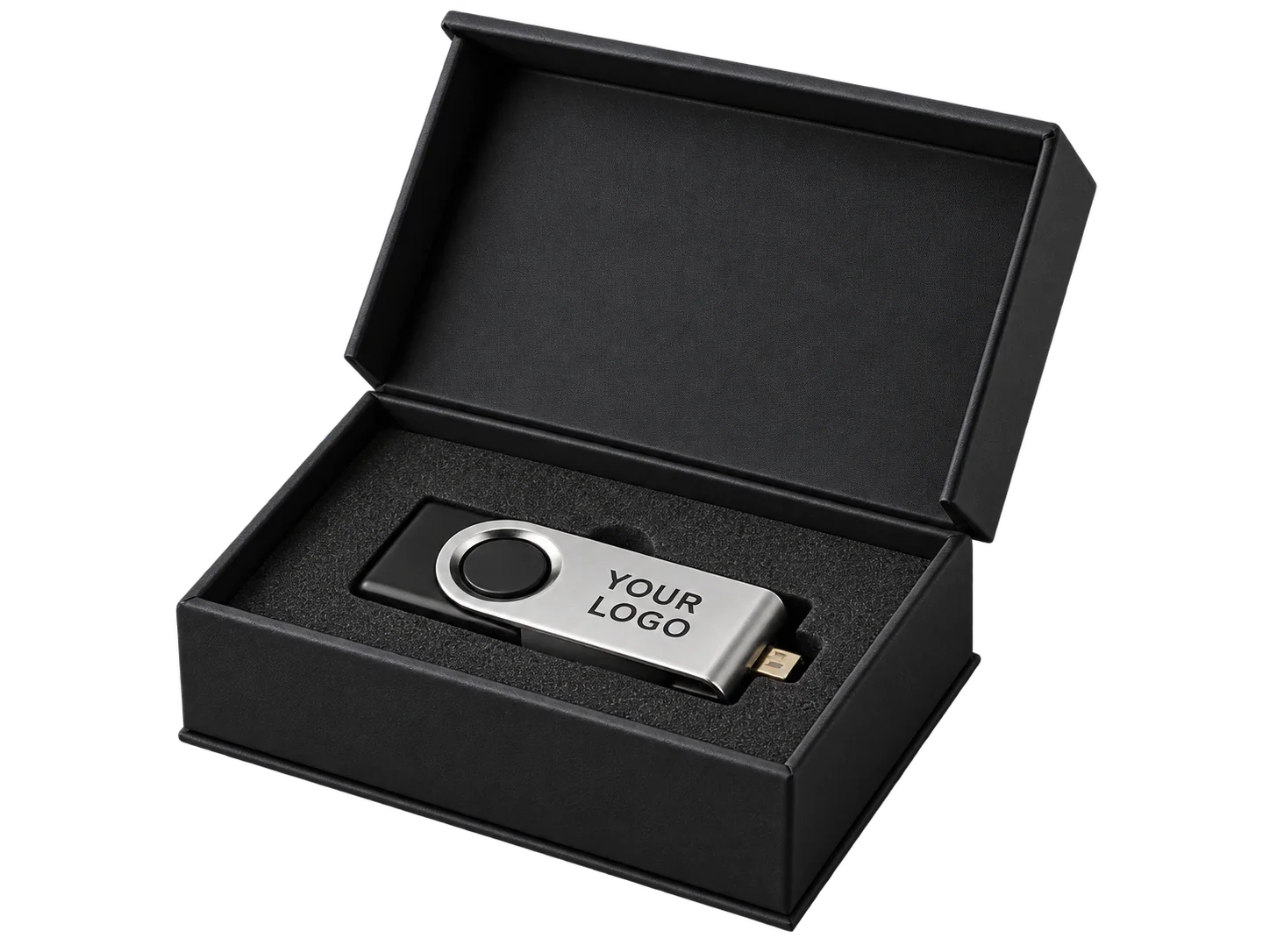
How Much Do Branded USB Sticks Cost? A UK Pricing Guide for 2026
At a glance
- Branded USB sticks in the UK start from around £1.27 per unit, with the exact price set by capacity, style, branding method and quantity.
- Minimum order quantities are low – often from just 10 units.
- Buying in higher volumes brings the per-unit cost down significantly.
- Always ask for a sample and a tailored quote before ordering.
Few questions are asked more often by UK marketing teams, event organisers, and procurement managers than this one: how much do branded USB sticks cost? The answer most suppliers give is frustratingly vague. Many of the largest names in the UK market refuse to publish prices online, requiring a quote form for every enquiry. This guide takes a different approach. It sets out, in plain terms, what branded USB sticks actually cost in the United Kingdom in 2026, what drives the variation between quotes, and how to budget your next order with confidence.
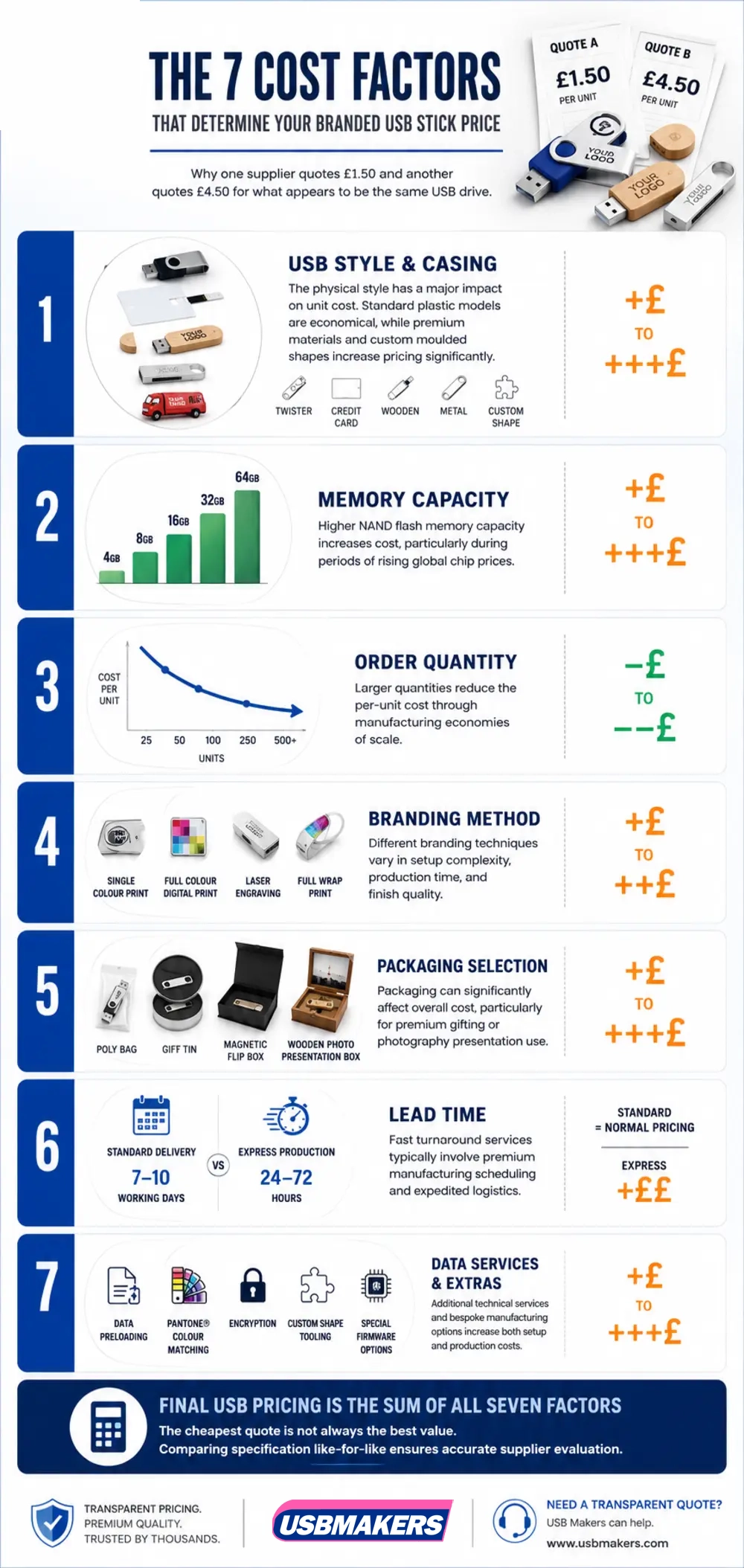
Pricing in this category is not arbitrary. Every quote is the sum of seven measurable cost factors. Once you understand each one, you will be able to predict your unit cost within a sensible range before you contact any supplier.
Why Branded USB Stick Prices Vary So Widely in 2026
A common source of buyer frustration is the gap between two quotes for what appears to be the same product. One supplier may quote £1.30 per unit, another £3.50. Both are quoting in good faith. The difference lies in the underlying components, the print method, the service level, and the volatility of the NAND flash memory market.
NAND flash is the silicon chip inside every USB stick that stores data. It is traded as a commodity and its price changes daily. During 2025 and into 2026, NAND prices have risen sharply. Major manufacturers such as Samsung, SanDisk, and Phison have implemented significant contract price increases, driven by record demand from artificial intelligence data centres and a reduction in legacy NAND production. The result is that branded USB stick pricing in 2026 sits noticeably higher than the same orders would have cost in 2023 or 2024. For a fuller explanation of these market dynamics, refer to our analysis of why USB flash drive prices are rising in 2025.
The practical implication is straightforward. A pricing guide published in 2026 will not match the prices you saw two or three years ago. It is also why responsible suppliers refresh their pricing daily rather than locking it in a printed brochure.
The Seven Factors That Determine the Cost of a Branded USB Stick
Every branded USB stick quote is built from the same seven inputs. Understanding each one is the foundation of any sensible procurement decision in this category.
1. USB Style and Casing Material
The physical shell of the USB stick is the most visible cost factor. A standard plastic twister USB sits at the lowest end of the range. Credit card, wooden, leather, metal, and luxury USBs each carry progressively higher unit costs as the materials and manufacturing complexity increase. Custom-shaped USBs – moulded into the shape of a product, mascot, or logo – sit at the top of the range because they require bespoke tooling.
As a general guide at typical promotional volumes, twister and plastic USBs start from around £1.27 per unit. Wooden and credit card USBs typically begin from approximately £2.00 to £2.50. Metal and luxury USBs commonly start from £3.00 upward. Custom-shaped PVC USBs vary widely by design complexity and usually include a one-off tooling fee. Browse our full range of branded USB sticks to see how the styles compare visually.
2. Memory Capacity
The amount of storage built into the USB stick has a direct effect on the unit price because NAND flash is the most expensive single component. Capacities commonly used for branded campaigns range from 1GB up to 64GB, with 8GB and 16GB being the most popular choices for trade shows, corporate events, and conference giveaways.
The price difference between capacities is not linear. Moving from 4GB to 8GB typically adds a modest amount per unit. Moving from 16GB to 32GB or 64GB adds considerably more, particularly in the current market where higher-capacity NAND is being absorbed by data-centre demand. For most campaigns, 8GB or 16GB represents the optimal balance between perceived value and cost.
3. Order Quantity
Branded USB sticks operate on a sliding price scale. The more units you order, the lower the cost per unit. This is because the fixed setup costs – artwork preparation, print plate creation, quality control – are spread across more units, and because suppliers can negotiate better component pricing at higher volumes.
A typical UK pricing curve looks something like this. At low volumes of 10 to 25 units, unit prices are at their highest because setup costs dominate. Between 50 and 100 units, prices fall meaningfully. Between 250 and 500 units, prices fall again. Beyond 1,000 units, the curve flattens. At USB Makers, the lowest minimum order quantity on selected USB drives is just 10 units, making the category accessible to smaller campaigns and to photographers ordering wedding USB sets.
4. Print Method
How your logo is applied to the USB stick affects the price. The four most common methods used in the UK market are screen printing, full-colour digital print, laser engraving, and full-wrap printing.
- Screen printing is the most cost-effective method for single-colour and two-colour logos in volume. It is highly durable and produces a clean, professional finish.
- Full-colour digital print reproduces complex artwork, gradients, and photographic detail. It carries a small premium over screen printing but is essential for logos with multiple colours or fine detail.
- Laser engraving is used on wooden, leather, and metal USBs to produce a permanent, etched mark. It uses no ink and never fades. Setup costs are slightly higher, but engraving produces a premium finish that screen printing cannot replicate.
- Full-wrap printing covers the entire surface of the USB casing with artwork. It is the most visually impactful option and is priced accordingly.
The number of print positions also matters. A logo applied to one side of a twister USB costs less than a logo applied to both sides. Detailed guidance is available in the USB artwork guidelines.
5. Packaging
Packaging is often overlooked at the quotation stage and then added late, inflating the final invoice. It deserves to be considered upfront. The simplest option is a plain poly bag, which adds a small cost per unit. Card boxes, metal tins, magnetic flip boxes, and wooden photo boxes each add progressively more.
Packaging matters most when the USB is positioned as a corporate gift or a wedding deliverable. A wooden USB in a wooden gift box communicates very differently from the same USB in a poly bag. For event giveaways at scale, poly bags or simple card sleeves are usually the right choice. For client gifts and photographer deliveries, premium packaging earns its cost back in perceived value. See the full range of branded USB packaging options to understand how packaging changes the buyer experience.
6. Lead Time
Speed costs money. A standard branded USB order in the UK is typically produced within 7 to 10 working days from artwork approval. This service level offers the best price because production is scheduled efficiently in the factory and shipped via standard freight.
If the order is needed faster, express service is available. At USB Makers, express turnaround is offered in 3 to 5 working days or, where stock and capacity permit, within 24 hours. Express service typically carries a premium of 15 to 35 percent over the standard unit price. For event marketers facing fixed exhibition dates, the premium is usually worth paying. Full details of the express USB service set out what is achievable within the tightest deadlines.
7. Data Preloading and Other Extras
Several optional extras can be added to a branded USB order: data preloading, Pantone colour matching, custom packaging, and encryption.
Data preloading allows you to ship USB sticks with brochures, presentations, video files, product catalogues, or any other digital content already on the drive. Preloading is typically offered free up to a defined data limit, with larger files attracting a modest fee. The pre-loaded data service is one of the highest-impact extras, transforming a USB from a generic giveaway into a controlled marketing asset.
Pantone matching ensures the USB casing matches your brand colour precisely. It requires custom moulding or matched-finish production and is typically charged as a flat setup fee plus a small per-unit premium.
Encryption is essential for regulated sectors such as legal, financial, and healthcare. Hardware-encrypted USBs cost significantly more per unit than standard drives but are necessary where sensitive data is involved. See the full range of SafeToGo encrypted USB sticks for compliance-led buyers.
Indicative 2026 Pricing for the Most Popular Branded USB Styles
The following figures are indicative starting prices for standard 8GB USB sticks with a single-colour print on one side, ordered at typical commercial volumes for the UK market. They exclude packaging upgrades, express service, and bespoke shapes. Final pricing is subject to NAND flash market conditions on the day the order is placed.
Twister USB Sticks
The most popular and most cost-effective option for high-volume campaigns. A standard 8GB twister USB typically starts from around £1.27 per unit at order quantities of 250 or more. At smaller volumes of 50 to 100 units, unit prices typically sit between £1.80 and £2.50. Twister USBs are the right choice for trade shows, conferences, and brand awareness campaigns where the volume of distribution matters more than premium presentation.
Credit Card USB Sticks
Credit card USBs are flat, business-card-sized drives that offer a large print area for full-colour artwork. They are particularly effective when the brand identity, contact details, or a QR code are part of the design. Indicative starting prices in 2026 sit from around £2.00 per unit at higher volumes, rising to approximately £3.00 to £3.50 per unit at lower quantities.
Wooden USB Sticks
Wooden USBs combine a sustainable material with laser-engraved branding, making them particularly popular with photographers, eco-conscious corporates, and premium gift programmes. Indicative starting prices begin from around £2.50 per unit at higher volumes, with smaller orders typically priced between £3.50 and £5.00 per unit.
Metal and Luxury USB Sticks
For executive gifting and high-value corporate use, metal and luxury USBs offer a premium look and feel. Indicative starting prices begin from around £3.00 per unit at volume, rising significantly for smaller orders or higher capacities. These styles are often paired with magnetic flip boxes or metal presentation tins, adding to the total package price.
Custom-Shaped USB Sticks
Bespoke PVC USBs moulded in the shape of a product, mascot, or logo carry the widest pricing range of any style. A typical custom USB project includes a one-off tooling fee, usually between £200 and £800 depending on complexity, plus a unit price that reflects the moulding cost. Volumes are usually higher (500 units and above) to justify the tooling investment. Custom USBs deliver the strongest brand recall of any format and are worth the higher cost where memorability is the campaign objective. The custom USB process page explains how a bespoke design is taken from concept to finished product.
What a Sample Quote Actually Looks Like
To illustrate how the seven factors combine in practice, consider a typical quote for a mid-sized trade show campaign. A marketing manager at a software company is exhibiting at a conference in Manchester. The brief is for 250 branded USB sticks, 8GB capacity, screen-printed with a two-colour logo, supplied in poly bags, and delivered within 10 working days. The chosen style is a twister USB in the company’s primary brand colour.
The supplier’s quote breaks down as follows. The base unit price for a twister USB at 8GB at 250 units sits at around £1.40 per unit. The two-colour screen print adds a small premium. Poly bag packaging is included. The 10-day lead time is standard, so no express premium applies. Free UK delivery is included. The total invoice comes in at approximately £375 plus VAT, with no setup fees and no hidden charges.
If the buyer instead needs the order in three working days, the express premium of approximately 25 percent takes the total closer to £470 plus VAT. Upgrading to magnetic flip box packaging for executive recipients moves the total higher again. This is why no two quotes are alike, and why understanding the cost drivers is essential before requesting a quote.
How to Reduce the Cost of Your Branded USB Order Without Compromising Quality
There are several legitimate ways to bring down the cost of a branded USB order. None of them involve cutting corners on chip quality or print durability.
- Increase order quantity to reach the next pricing tier. If you are quoting at 230 units, ask your supplier for a quote at 250. The per-unit saving across the entire order often exceeds the additional cost of the extra units.
- Choose the right capacity, not the highest. An 8GB USB stick is sufficient for almost every campaign. Specifying 32GB or 64GB without a reason will inflate the unit price unnecessarily, particularly in the current NAND market.
- Plan the lead time honestly. Express service is a genuinely useful tool when an event date is fixed, but it should not become the default. Booking standard lead times saves a meaningful percentage on the unit cost.
- Be deliberate about packaging. Match the packaging to the recipient. Polished gift boxes for VIPs and clients; poly bags for mass distribution. Mixing the two within a single order is often the most efficient approach.
- Submit print-ready artwork. Suppliers that offer free artwork preparation, such as USB Makers, will not charge for tidying up a logo. Supplying clean vector artwork from the outset still removes one of the most common causes of delay.
- Use a UK supplier with factory-direct pricing. A UK-based supplier operating its own production facility eliminates intermediary markup, which is usually visible in the per-unit price and the turnaround speed.
Why Some Suppliers Refuse to Publish Pricing
Several major UK suppliers will not publish prices online, arguing that NAND flash volatility makes printed prices unreliable. There is some truth to this. NAND prices change daily, and any published figure is a snapshot rather than a fixed quote. However, the practical effect of the quote-form model is that pricing comparison becomes difficult, and suppliers gain leverage to vary prices based on perceived buyer urgency. Suppliers willing to publish indicative starting prices – while making clear that final quotes are subject to current market conditions – give buyers what they need to decide with confidence. Transparent pricing is, on balance, a sign of supplier confidence, not weakness.
Help & Support
Frequently Asked Questions
At higher volumes of 250 units or more, twister USB sticks at 8GB capacity typically start from around £2.27 per unit at USB Makers. This is the entry point for cost-effective bulk branded USB campaigns in 2026.
Wooden USB sticks with laser-engraved branding typically start from around £2.50 per unit at higher volumes. Smaller orders, in the range of 25 to 100 units, generally fall between £3.50 and £5.00 per unit depending on capacity and packaging.
Reputable UK suppliers, including USB Makers, do not charge setup fees on standard branded USB orders. Custom-shaped PVC USBs, which require bespoke moulds, do carry a one-off tooling fee, typically between £200 and £400 depending on design complexity.
The minimum order quantity varies by supplier and by USB style. At USB Makers, the lowest minimum on selected USB drives is just 10 units, making the category accessible for photographers, small businesses, and pilot campaigns. Larger competitors often require minimum orders of 25, 50, or 100 units.
Standard production runs are typically completed within 7 to 10 working days from artwork approval. Express service, available at a premium, can deliver branded USB sticks within 3 to 5 working days or, in some cases, within 24 hours. Lead times depend on the chosen USB style, the order quantity, and current factory capacity.
Yes. NAND flash memory prices have risen sharply during 2025, with further increases projected by industry analysts including TrendForce. Buyers planning campaigns for later in 2026 are typically advised to lock in pricing earlier rather than later, particularly for high-capacity drives.
At USB Makers, UK delivery is included free of charge on standard orders. Other suppliers vary in their policy, with some charging delivery fees that should be checked at the quotation stage to ensure a like-for-like comparison.
Most UK suppliers offer plain (unbranded) samples for evaluation. Branded samples are sometimes available for a small fee that covers the setup costs of a one-off print. Requesting a sample is strongly recommended before committing to a large order, particularly for premium styles such as wooden, leather, or metal USBs.
Conclusion
Branded USB stick pricing in the United Kingdom is more transparent than the wider market lets on. Every quote breaks down into the same seven cost factors: style, capacity, quantity, print method, packaging, lead time, and extras. Once those factors are understood, the pricing variation between suppliers becomes much easier to evaluate, and buyers are able to budget projects with real confidence.
The current market environment, shaped by rising NAND flash prices and strong demand for branded tech merchandise, makes early ordering and informed buying more valuable than ever. Suppliers that publish indicative pricing, offer low minimum order quantities, and provide free UK delivery as standard are best positioned to support UK businesses through 2026.
If you are planning a branded USB campaign and would like a clear, no-obligation quote, request a quote from the USB Makers team. A typical response includes a transparent unit price, lead time, and packaging recommendation within one working day.