Branded USB Sticks Buyer’s Guide: What UK Businesses Need to Know Before Ordering
At a glance
- Before ordering, get clear on capacity, style, branding method, quantity and deadline.
- Minimum order quantities are low and the unit price falls as volumes rise.
- Insist on quality flash and controllers for drives that last.
- Ask for a proof and a sample before committing to a full run.
Updated on 6 April 2026
Ordering branded USB sticks for a promotional campaign, corporate event, or client gift should be straightforward. In practice, it rarely is. Between choosing the right style, selecting the correct storage capacity, deciding on a branding method, and finding a supplier who can deliver on time and on budget, the process involves more decisions than most marketing managers expect.
This guide covers every factor UK businesses need to consider before placing an order for promotional USB drives. Whether the drives are destined for a trade show giveaway, a direct mail campaign, a photographer’s client delivery, or an executive gift set, the information below will help ensure the finished product is fit for purpose, represents the brand well, and delivers genuine return on investment.
The UK promotional products market is valued at approximately £1.2 billion in 2026, and demand for practical, reusable items continues to grow. Industry research consistently shows that recipients keep useful promotional products for a year or more, and around 83% of consumers remember the brand printed on an item they have received. Branded flash drives sit squarely in this category – they are functional, portable, and used repeatedly, which means extended exposure for the logo printed on them.
How to Choose the Right USB Stick Style for Your Campaign
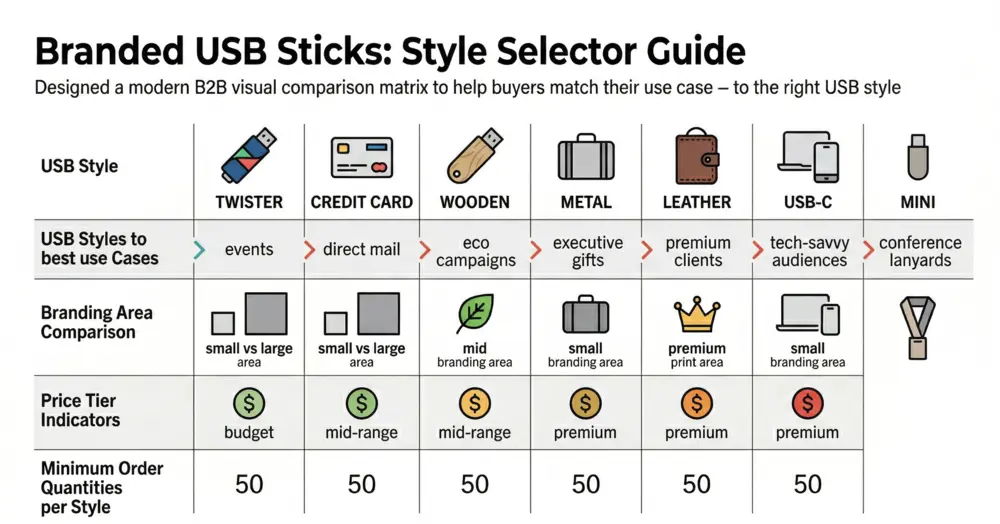
The style of USB stick selected should reflect both the brand identity and the intended use case. A drive handed out at a busy exhibition stand has very different requirements from one included in a premium client welcome pack. Below are the most common styles and where they perform best.
The Twister USB remains the most popular choice for large-scale promotional campaigns. Its rotating cover protects the connector, and the flat body provides a generous print area on both sides. It is cost-effective at higher quantities, making it ideal for trade shows, conferences, and event giveaways where volume matters.
Credit Card USB sticks are exceptionally thin and designed to fit inside a wallet or cardholder. This makes them a strong option for direct mail campaigns, as they slip easily into envelopes. The full-surface print area allows for detailed, full-colour branding – effectively turning the drive into a portable business card that also stores data.
For campaigns with an environmental message, Wooden USB sticks and other eco-friendly options communicate sustainability without saying a word. These drives are manufactured from responsibly sourced timber or recycled materials and can be laser engraved for a natural, premium finish. With over 46% of consumers expressing a preference for eco-friendly promotional items, this is a positioning advantage worth considering.
Metal USB sticks offer durability and a sleek, professional appearance. Laser engraving on brushed metal creates a refined look that suits corporate gifts, executive presentations, and luxury brand activations. Leather USB sticks occupy a similar premium tier, with embossed or debossed branding that conveys quality and craftsmanship.
For maximum brand impact, Custom PVC USB sticks can be manufactured in virtually any 2D or 3D shape. A logistics company might order drives shaped like delivery trucks. A food brand might choose a design that mirrors its signature product. Custom shapes generate conversation, which extends the reach of the promotional investment well beyond the initial recipient.
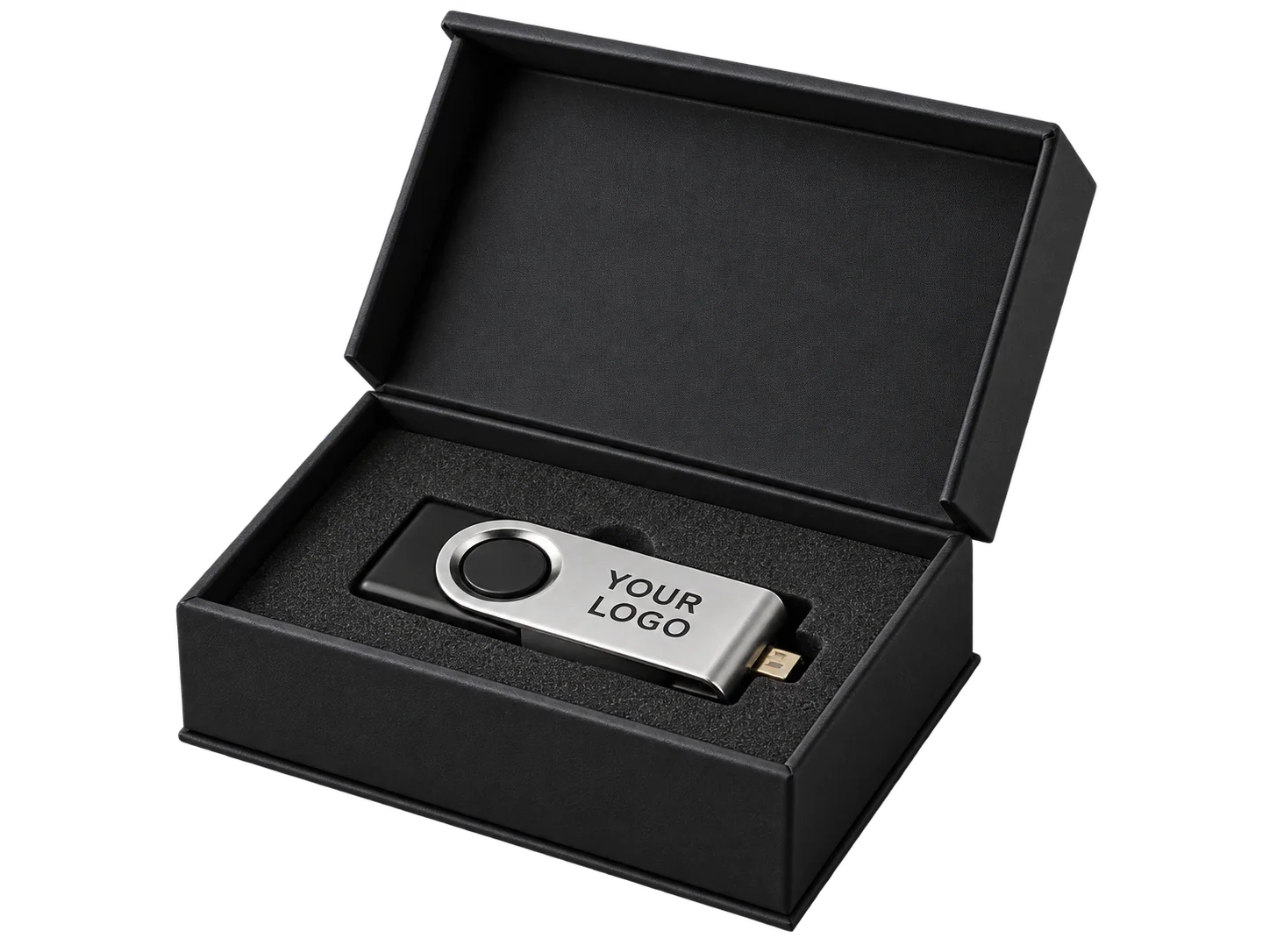
Luxury USB sticks are designed for high-value client relationships where presentation matters as much as the product itself. Combined with premium USB packaging, these drives create a memorable unboxing experience that reinforces brand perception.
Selecting the Right Storage Capacity
Storage capacity directly affects both cost and usefulness. Ordering drives with too little memory results in a product that recipients cannot use for their own files, which reduces the likelihood of the drive being kept. Ordering drives with excessive capacity wastes budget on storage that will never be utilised.
For most promotional campaigns where the primary purpose is brand visibility, 8GB to 16GB represents the optimal range. This provides enough space for preloaded marketing materials – brochures, presentations, product catalogues, or video content – while leaving sufficient room for the recipient to store their own documents.
If the drives will be used for data-heavy applications, such as distributing high-resolution photography, architectural plans, software packages, or video portfolios, 32GB or 64GB is more appropriate. Photographers, for example, frequently require 32GB or above to deliver full wedding or portrait galleries to clients.
For simple branding exercises where no data will be preloaded and the drive is purely a giveaway item, 4GB can be sufficient – though it is worth noting that the price difference between 4GB and 8GB is often marginal, and the higher capacity makes the product noticeably more useful to the recipient.
A practical rule of thumb: choose a capacity large enough to hold the preloaded content plus at least 50% additional free space. This ensures the drive has genuine utility beyond the initial marketing message, which is what keeps it on the recipient’s desk rather than in a drawer.
USB-C vs USB-A: Which Connector Should UK Businesses Choose in 2026?
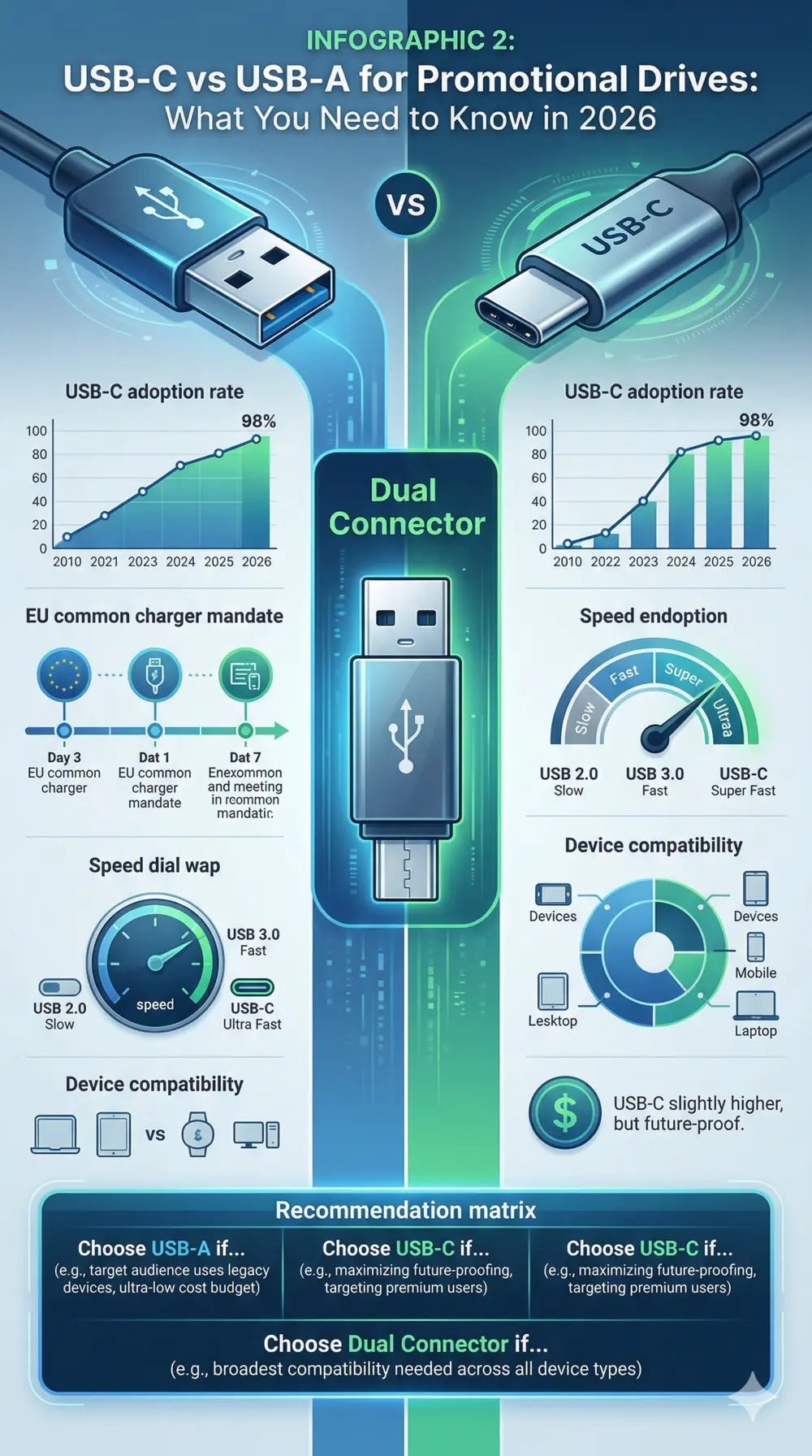
The shift from USB-A to USB-C is one of the most significant considerations for businesses ordering promotional drives in 2026. The EU common charger directive, which came into effect in late 2024, mandated USB-C as the standard charging port for a wide range of consumer electronics. Industry data indicates that over 85% of new smartphones launched in 2024 already featured USB-C connectivity, and forecasts predict near-universal adoption in premium devices by 2026.
For branded USB sticks, this creates a practical question: will the recipients’ devices have USB-A ports, USB-C ports, or both?
The answer depends largely on the target audience. Businesses distributing drives at technology-focused events, to younger demographics, or to organisations known for using recent hardware should strongly consider USB-C or dual-connector (OTG) drives. For broader audiences where older laptops and desktops remain in use, USB-A continues to offer the widest compatibility.
Dual-connector OTG drives that feature both USB-A and USB-C on a single device are an increasingly popular solution. They eliminate the compatibility question entirely, ensuring the drive works regardless of the recipient’s hardware. This makes them particularly well suited to large-scale campaigns where the audience’s device profile is varied or unknown.
For a detailed comparison of both connector types and guidance on which is right for a specific campaign, the USB-C vs USB-A comparison page provides additional context.
Understanding Branding Methods for Printed USB Sticks
The branding method determines how the logo and artwork appear on the finished drive. Different methods suit different materials, design complexities, and budget levels. Choosing the wrong method can result in artwork that does not reproduce well or wears off prematurely.
Screen Printing is the most common method for printed USB sticks. It works well on flat surfaces and produces crisp, vibrant results for logos with solid colours. It is cost-effective at scale and suits the majority of standard USB styles.
Photo Printing (also known as digital or full-colour printing) allows for photographic-quality reproduction, including gradients, complex imagery, and full-colour designs. This is the preferred method for credit card USBs and any design that requires more than a few spot colours.
Laser Engraving etches the design permanently into the surface of the drive. It is most effective on metal and wooden USB sticks, producing a subtle, sophisticated finish that will not fade, peel, or wear off over time. For brands that prioritise longevity and a premium feel, engraving is the strongest choice.
Pantone Matching ensures the body colour of the USB stick matches the brand’s exact corporate colour. This level of consistency is particularly important for organisations with strict brand guidelines and for campaigns where multiple branded items need to look cohesive.
For more detail on how each method works and which is best suited to a particular design, the Logo Branding page provides a full overview with examples.
Eco-Friendly Branded USB Drives: Meeting Sustainability Expectations
Sustainability is no longer a differentiator in B2B marketing – it is an expectation. Research indicates that over 72% of consumers prefer receiving promotional items made from eco-friendly or sustainable materials. For UK businesses operating under increasing pressure to demonstrate environmental responsibility, the choice of materials for promotional USB drives sends a clear signal.
Options include USB sticks manufactured from recycled plastic, FSC-certified wood, bamboo, wheat straw, and biodegradable compounds. These materials do not compromise on functionality or durability; they simply replace conventional plastics with alternatives that carry a lower environmental footprint.
Pairing eco-friendly drives with recyclable or minimal packaging further strengthens the sustainability message. Some businesses choose to include a printed card explaining the materials used and the environmental benefit, which reinforces the brand’s commitment and gives recipients a reason to talk about the product.
For organisations reporting on corporate social responsibility (CSR) or environmental, social, and governance (ESG) metrics, selecting sustainable promotional products contributes directly to those reporting frameworks. It is a practical way to align marketing spend with broader organisational values.
Data Preloading: Turning a Promotional Item into a Marketing Tool
A blank branded USB stick is a useful promotional product. A branded USB stick loaded with valuable content is a marketing tool. Data preloading transforms the drive from a passive branding exercise into an active engagement mechanism.
Common preloaded content includes product catalogues, company presentations, pricing guides, case studies, video showreels, software demos, and digital brochures. Educational institutions preload course materials. Photographers preload client galleries. Event organisers preload speaker presentations and delegate resources.
The key to effective preloading is ensuring the content is genuinely valuable to the recipient. A drive loaded with a generic company brochure is unlikely to generate much engagement. A drive loaded with an exclusive industry report, a practical toolkit, or a resource the recipient would otherwise need to find elsewhere creates immediate perceived value – and a reason to plug the drive in.
Content can also be locked so that the marketing files remain permanently on the drive and cannot be deleted, while the remaining free space is available for the recipient’s own use. This ensures the brand message persists for the lifetime of the product.
Packaging and Presentation: The Details That Elevate Perception
The packaging in which a branded USB stick is delivered significantly affects how the product is perceived. A high-quality drive presented in premium USB packaging – whether a printed gift box, a magnetic closure case, or a tin with a foam insert – communicates value and professionalism. The same drive dropped loose into a polythene bag does not.
For trade show giveaways distributed in high volume, packaging may be unnecessary – or a simple branded sleeve may suffice. For client gifts, employee welcome packs, or direct mail campaigns, investing in presentation packaging dramatically increases the perceived value of the item and the likelihood that it will be kept and used.
Packaging also presents an additional branding opportunity. A printed box carries the logo, message, or campaign artwork, extending the visual real estate beyond the drive itself.
Minimum Order Quantities and Budget Considerations
One of the most common barriers for smaller businesses is the assumption that promotional USB drives require large minimum orders. This is not always the case. Low minimum order quantities – in some cases as few as 10 units – make branded drives accessible to businesses of all sizes, from startups ordering for a product launch to enterprises ordering thousands for a national campaign.
When evaluating pricing, it is important to confirm what is included in the quoted figure. The total cost should encompass the drive itself, branding setup, printing, data preloading (if applicable), packaging, and delivery. Hidden charges for setup fees, artwork preparation, or delivery can significantly inflate the final cost.
Unit prices decrease as order quantities increase, so businesses with ongoing requirements may benefit from placing larger, less frequent orders rather than multiple small ones. It is also worth asking about price match guarantees – reputable suppliers will match or beat genuine like-for-like quotes.
Turnaround Times and Express Delivery
Lead times vary depending on the product style, order quantity, level of customisation, and supplier. Standard production for custom USB sticks for business typically takes between 7 and 14 working days from artwork approval to delivery. More complex orders – such as custom-shaped PVC drives or large quantities with data preloading – may require additional time.
For time-sensitive requirements, express services can deliver branded USB sticks within 24 hours on selected styles. This is particularly valuable for last-minute event orders, urgent client presentations, or campaigns with compressed timescales. However, express orders typically limit the available style and colour options, so planning ahead wherever possible remains the most cost-effective approach.
When working to a fixed deadline – a trade show date, a product launch, or a marketing campaign start – it is advisable to communicate the required delivery date to the supplier at the outset. This allows the production schedule to be planned around the deadline, reducing the risk of delays.
How to Choose a Reliable UK Supplier for Branded USB Sticks
The supplier selected will determine the quality of the product, the accuracy of the branding, and the reliability of the delivery. When evaluating potential suppliers, consider the following criteria.
Track record and reviews: Established suppliers with verifiable customer reviews on platforms such as Trustpilot and Google Reviews provide the strongest assurance of quality and service. Look for consistent positive feedback specifically around print quality, delivery reliability, and communication.
Visual proofs: A reputable supplier will provide a visual mock-up of the finished product before production begins. This allows the buyer to confirm that the logo placement, colours, and overall appearance meet expectations before committing to the full order.
Component quality: Not all USB drives are manufactured to the same standard. Cheaper drives may use lower-grade flash memory chips that result in slower transfer speeds and higher failure rates. Confirm that the supplier uses Grade A NAND flash chips and provides warranty coverage against defects.
Artwork support: Buyers do not always have print-ready artwork. A good supplier will offer guidance on artwork preparation and may adjust or optimise files at no additional cost to ensure the best possible print result.
Range and flexibility: The supplier should offer a broad range of styles, capacities, and branding methods. This allows the buyer to match the product precisely to the campaign brief rather than settling for whatever happens to be available.
Industry-Specific Use Cases for Branded USB Drives
Understanding how different industries use branded flash drives can help inform purchasing decisions and identify opportunities that may not be immediately obvious.
Marketing agencies frequently order branded drives as part of pitch presentations or campaign deliverables, preloading them with strategy documents, creative assets, or media plans. A branded USB stick delivered in premium packaging elevates the perceived value of the work and creates a physical touchpoint that digital delivery cannot replicate.
Events companies use drives to distribute delegate packs, speaker presentations, exhibitor directories, and post-event resources. Branded drives given to attendees at registration serve a dual purpose: they provide useful content and promote the organiser’s brand for months after the event.
Corporate clients order branded USB sticks for employee onboarding packs, training materials distribution, client welcome gifts, and internal communications. Consistent branding across all touchpoints, including promotional items, reinforces organisational identity.
Professional photographers rely on branded USB sticks as the primary delivery method for client images. A beautifully presented USB drive, engraved with the photographer’s logo and packaged in a quality box, transforms a simple file transfer into a premium client experience that encourages referrals.
Educational institutions distribute preloaded drives containing course materials, software, digital prospectuses, and welcome information to students during enrolment and orientation periods.
Help & Support
Frequently Asked Questions
Minimum order quantities vary by supplier and product style. Some suppliers require a minimum of 25 or 50 units, but it is possible to order branded USB sticks from as few as 10 units, making them accessible for small businesses, startups, and pilot campaigns.
Standard production typically takes 7 to 14 working days from artwork approval. Express services can deliver selected styles within 24 hours for urgent requirements.
This depends on the target audience’s devices. USB-A remains widely compatible with older hardware, while USB-C is standard on most new laptops, tablets, and smartphones. For maximum compatibility, dual-connector OTG drives with both USB-A and USB-C are the safest choice.
Yes. Most promotional USB suppliers offer a data preloading service that copies specified files onto every drive before dispatch. Content can include documents, presentations, videos, software, and more. Files can optionally be locked to prevent deletion.
For most promotional purposes, 8GB to 16GB offers the best balance of cost and usefulness. If preloading large files such as video content or high-resolution image galleries, 32GB or 64GB is more appropriate.
Yes. Options include drives made from recycled plastic, FSC-certified wood, bamboo, and biodegradable materials. These are fully functional and available with the same branding methods as standard drives.
The main methods are screen printing (solid-colour logos), photo printing (full-colour and photographic designs), and laser engraving (permanent etching on metal and wood). Pantone matching is also available to ensure exact colour accuracy on the drive body.
Request a visual proof before production begins. Confirm the supplier uses Grade A NAND flash chips, and check independent reviews on Trustpilot and Google. Established UK suppliers with a strong track record are the safest choice.
Conclusion
Ordering branded USB sticks involves more decisions than the product’s size might suggest. Style, capacity, connector type, branding method, materials, packaging, preloaded content, and supplier selection all influence whether the finished product achieves its intended purpose – or falls short.
The businesses that get the most from their promotional USB investment are those that approach the process strategically: matching the product to the audience, investing in quality over quantity, and working with a supplier that offers guidance, flexibility, and reliable delivery.
For UK businesses ready to explore options, requesting a free, no-obligation quote is the fastest way to get started. Alternatively, contact the team directly to discuss specific requirements and receive expert advice tailored to the campaign brief.